Developing Responsible Sea Moss Farms – A Viable Blue Economy Initiative for Coastal Communities
The vision began with a single strand of sea moss. It grew through observation, testing, and deliberate planning, not by chance.
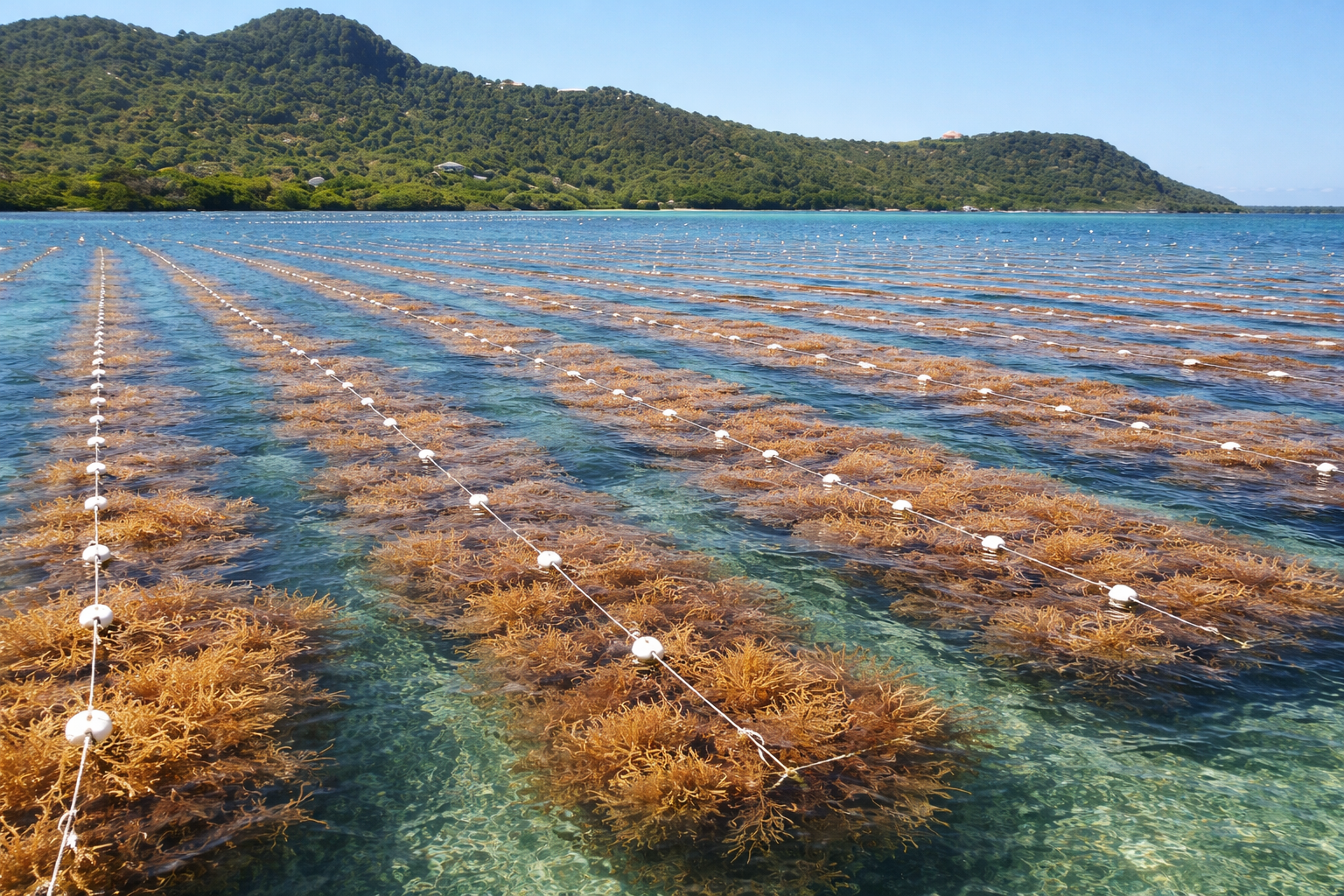
Over the past five-plus years, we have conducted field observations, pilot trials, and applied experiments across multiple Caribbean coastal environments, including St. Vincent and the Grenadines, Grenada, and The Bahamas. These locations share similar marine conditions, making them ideal learning grounds for developing responsible, scalable sea moss farming models applicable across Small Island Developing States (SIDS) and other tropical coastlines.
One of the earliest case studies emerged in St. Vincent and the Grenadines, where we revitalised sea moss farming on Union Island, pioneered sea moss farming activity on Bequia and provided technical assistance and training support to farmers and community groups in Mayreau and Canouan (the Grenadines). These early-stage interventions focused on reviving healthy sea moss stocks, identifying suitable marine environments, and improving yield per frame through responsible placement and farm management.
 This work represented early-stage development, not extraction. The priority was always to restore and strengthen planting material first, then test scalability across different bays and coastal conditions. Similar exploratory work and observations were also carried out in Grenada and The Bahamas, where environmental conditions further validated the potential for regional replication.
The objective across all locations was consistent:
to demonstrate how coastal communities can move from small, informal activity to responsible, large-scale sea moss production capable of supporting sustainable livelihoods.
Through demonstrations and technical guidance, we focused on showing how sea moss enterprises could scale from a single rope to well-managed farms, planted in appropriate marine spaces, governed by environmental care, and aligned with export realities.
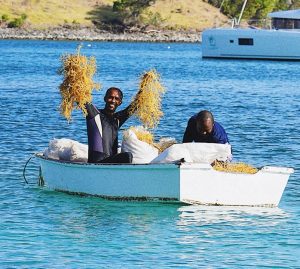 A second, equally important objective was economic. Many fishers and coastal workers already invest significant physical labour for minimal returns. Responsible sea moss farming offers a pathway to improved income, but only when production systems are designed correctly from the start.
Did you know?
It takes 20 lbs of wet sea moss to produce just 1 lb of dry sea moss.
Export markets demand volume, consistency, and compliance. One rope or small plot alone cannot meet these requirements. Countries such as the Philippines, which produces over 190 tonnes annually, illustrate what is possible when production systems are scaled responsibly.
With the right technical approach, sea moss farming can transition from subsistence activity to a viable blue economy investment.
What this enables:
• Increased local production
• Jobs in coastal communities
• Innovation in value-added products
• Stronger domestic and export markets
• More money circulating locally
• Measurable GDP contribution
This is how nations build wealth from their own marine resources.
This is how livelihoods and marine health advance together.
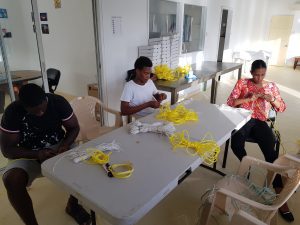 This work is led by Sustainable People & Communities Inc. (SPCI) under our Grow Healthy Program, which focuses on translating technical knowledge into real, measurable impact through training, applied learning, and ethical enterprise development.
In Barbados, the process has begun. We look forward to working closely with the Fisheries Division and Export Barbados as early-stage scaling and structured implementation move forward.
We are also available for consultations, technical support, and training for governments, NGOs, community groups, and private sector partners interested in responsible sea moss farming.
Finally, we welcome engagement from private investors who recognise the long-term value of sustainable aquaculture and blue economy development. The groundwork is being laid, responsibly, methodically, and with regional experience.
? Training & consultations: (246) 287-7435
Responsible sea moss farming
Value-added product development
From sea → shelf → market
Our nations thrive when our people produce.
? Support Our Work
Help us build healthier communities and stronger local economies.
This blog is published by Sustainable People & Communities Inc.(SPCI) through the Grow Healthy initiative.