January 23, 2026
Bridgetown, Barbados
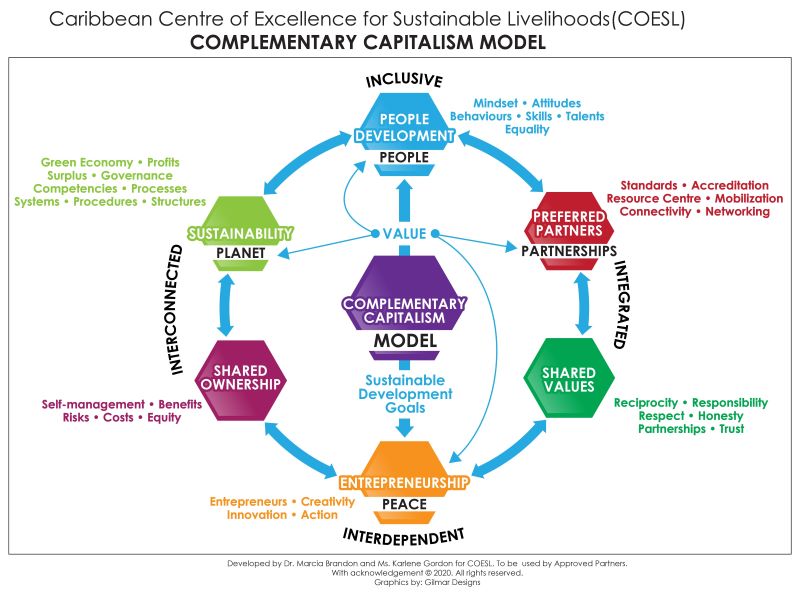
Let’s dive into partnerships in the Caribbean non-profit sector and how they drive sustainable development, especially through models like reciprocity and complementary capitalism (often called the Complementary Capitalism model or CCm conceptualised by Dr. Marcia Brandon, COESL—the Caribbean Centre of Excellence for Sustainable Livelihoods).
What is Complementary Capitalism / Reciprocity in This Context?
From what COESL, a Barbados-based non-profit founded by Caribbean female social entrepreneurs, practices and promotes, complementary capitalism is a deliberate philosophy: Non-profits, social enterprises, communities, and even private actors collaborate in ways that are mutually reinforcing, each brings strengths (e.g., local knowledge, networks, innovation, funding access) to create shared value, without one dominating or extracting.
It’s rooted in reciprocity, give and take that builds trust, strengthens institutions, and ensures no one is left behind. This aligns with the “4Ps” approach COESL uses: People, Planet, Peace, and Prosperity.It’s not traditional capitalism (profit-maximizing at all costs) or pure charity (one-way aid). Instead, it’s win-win collaboration where partners complement each other’s mandates, charity organizations handle immediate relief, advocacy groups push policy change, sustainable development NPOs focus on long-term resilience, and project management entities deliver execution.
Together, they achieve results that no single entity could alone, even under limited capital.How Partnerships Help Sustainable Development in the Caribbean. In the Caribbean (small islands, climate vulnerability, limited resources, post-colonial legacies), non-profits often operate in a hostile or indifferent environment, governments publicly state they want civil society partnerships (in SDGs, national development plans, etc.), but in practice, NPOs are frequently viewed as “enemies of the state” (critics of corruption, advocates for marginalized groups, or challengers to status quo deals). Despite this:
- Resilience Amid Challenges: Partnerships allow NPOs to pool resources, share risks, and amplify impact. COESL, for example, emphasizes building durable institutions through reciprocity, helping women, youth, and entrepreneurs of Caribbean/African descent create sustainable livelihoods via entrepreneurship, training, and networks.
- Overcoming Capital Constraints: Many NPOs run “capitalised” (business-like) operations to survive, selling services, products, or consulting, while delivering social good. Partnerships provide access to funding, expertise, markets, and legitimacy that governments or donors might withhold.
- Achieving Results: Examples include joint projects in eco-tourism, youth empowerment, climate adaptation, and community-based initiatives, where non-profits lead implementation, private partners bring scale/finance, and communities ensure relevance. This creates inclusive growth (economic empowerment, resilience, reduced inequality).
Practical Examples & Lessons
- COESL’s Model: Focuses on reciprocity to strengthen Caribbean institutions, e.g., partnering with regional bodies for training, relief (like hurricane supplies to St. Vincent and the Grenadines), and youth/women entrepreneurship. They operate under CCm to build complementary strengths, proving non-profits can thrive despite govt skepticism.
- Public-Private-Community Partnerships (PPCPs): In Caribbean tourism (e.g., community-based models in Jamaica’s Treasure Beach or other SIDS), non-profits facilitate engagement, communities gain jobs/revenue, private firms get sustainable operations, governments achieve SDGs. Key: Genuine consultation, shared benefits, monitoring, leading to economic empowerment, conservation, and resilience.
- Broader Caribbean Successes: Non-profits like those in climate resilience (biodiversity projects) or youth programs often partner regionally to bypass govt resistance, sharing knowledge, co-funding, and advocacy. This “complementary” approach turns limited mandates into collective power.
Challenges & Path Forward:
Governments often treat civil society as threats (advocacy seen as opposition), limiting funding/access. Non-profits’ diverse mandates (charity vs. advocacy vs. development) can cause fragmentation, but genuine partnerships bridge this, building the sector’s overall strength, not just individual gain.
Going forward:
Prioritize reciprocity, mutual respect, shared risks/rewards, transparency. We can all “eat a food” (benefit) if done right: Local-led, complementary collaborations that grow institutions sustainably, rather than extractive deals. This counters the “enemies of the state” narrative and delivers real Caribbean impact.
? Support Our Work
Help us build healthier communities and stronger local economies.
This blog is published by Sustainable People & Communities Inc.(SPCI) through the Grow Healthy initiative.